Climate Friday | Aluminium carbon accounting: why methodology matters
27 February 2026
Recycling aluminium can cut carbon emissions by up to 95 percent, yet depending on the accounting method used, the reported footprint can vary dramatically, placing greater responsibility on designers to understand exactly how aluminium’s carbon is measured.
Aluminium plays a vital role in the modern facade construction industry due to its versatility, durability and design flexibility. Its formability enables complex applications across cladding, glazing systems, roofing and fixings, while its corrosion resistance and low maintenance requirements allow for a service life exceeding 80 years (Hartman and Williams, 2024). Despite this, primary aluminium production is highly energy-intensive and contributes to approximately 2% of global greenhouse gas emissions (Wenjuan et al., 2023), making its sustainable use and specification a critical consideration for designers.
One of aluminium’s most significant environmental advantages is its inherent recyclability. When managed correctly, aluminium can be endlessly repurposed, remelted and reshaped without any loss of quality, while requiring only 5% of the energy used to produce primary aluminium (Hartman and Williams, 2024). Due to this, more suppliers now offer low-carbon recycled aluminium products supported by Environmental Product Declarations (EPDs). While this development is welcome, designers must ensure they understand the carbon accounting methods behind the EPD figures, as they play a decisive role in how a product’s environmental performance is presented. The following article examines the most common carbon accounting methods, exploring their assumptions and differences, in an aim to help clarify which method provides the most accurate and/or appropriate representation of embodied carbon.
Aluminium’s Life Cycle
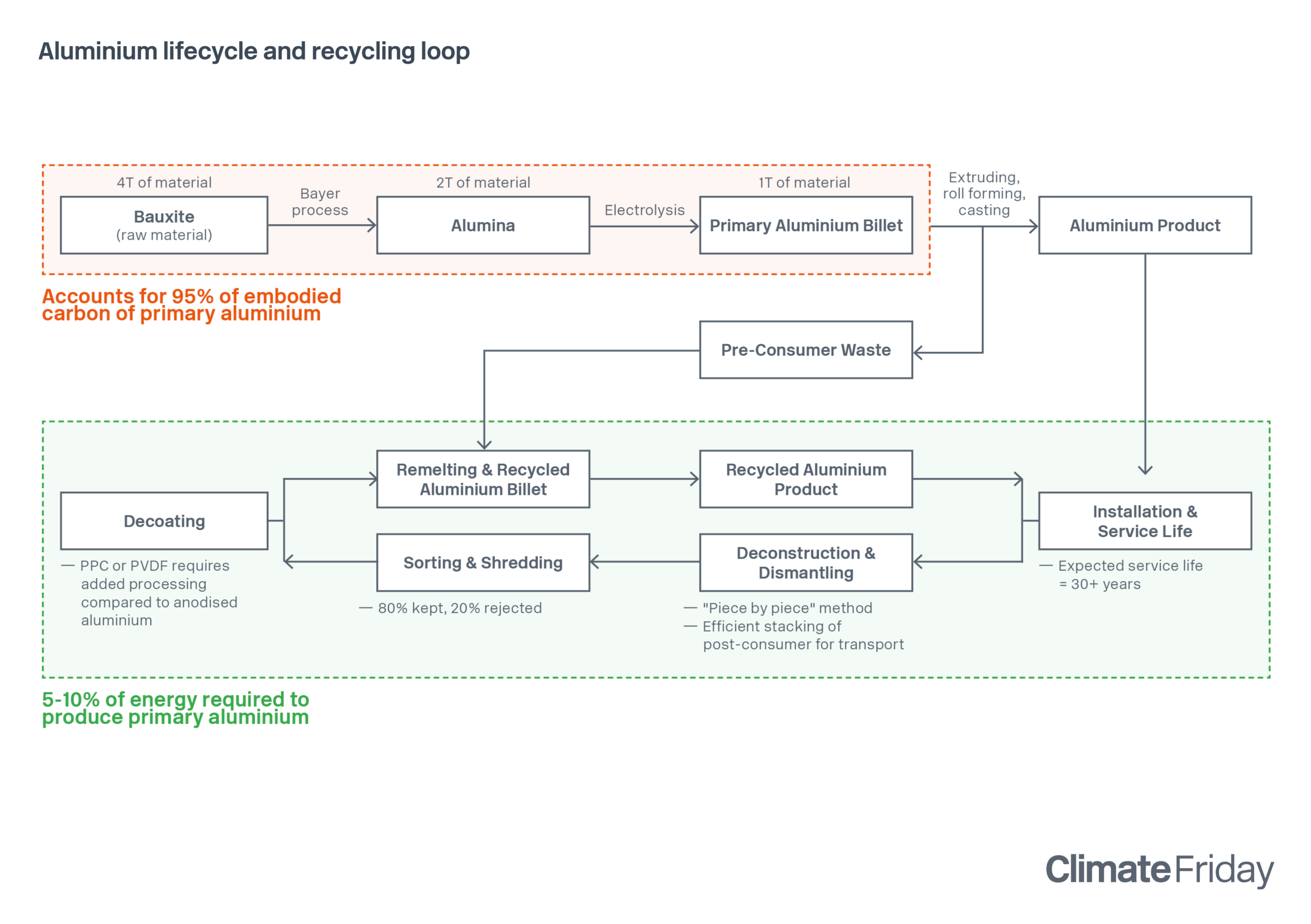
To understand the differences between carbon accounting methods, it is first necessary to consider the full life cycle of an aluminium product. The production of primary aluminium components occurs in four main stages. First, bauxite ore is mined and refined through the Bayer process to produce alumina. The alumina then undergoes electrolysis, converting it into primary aluminium, which is subsequently refined and extruded, rolled or cast into finished products.
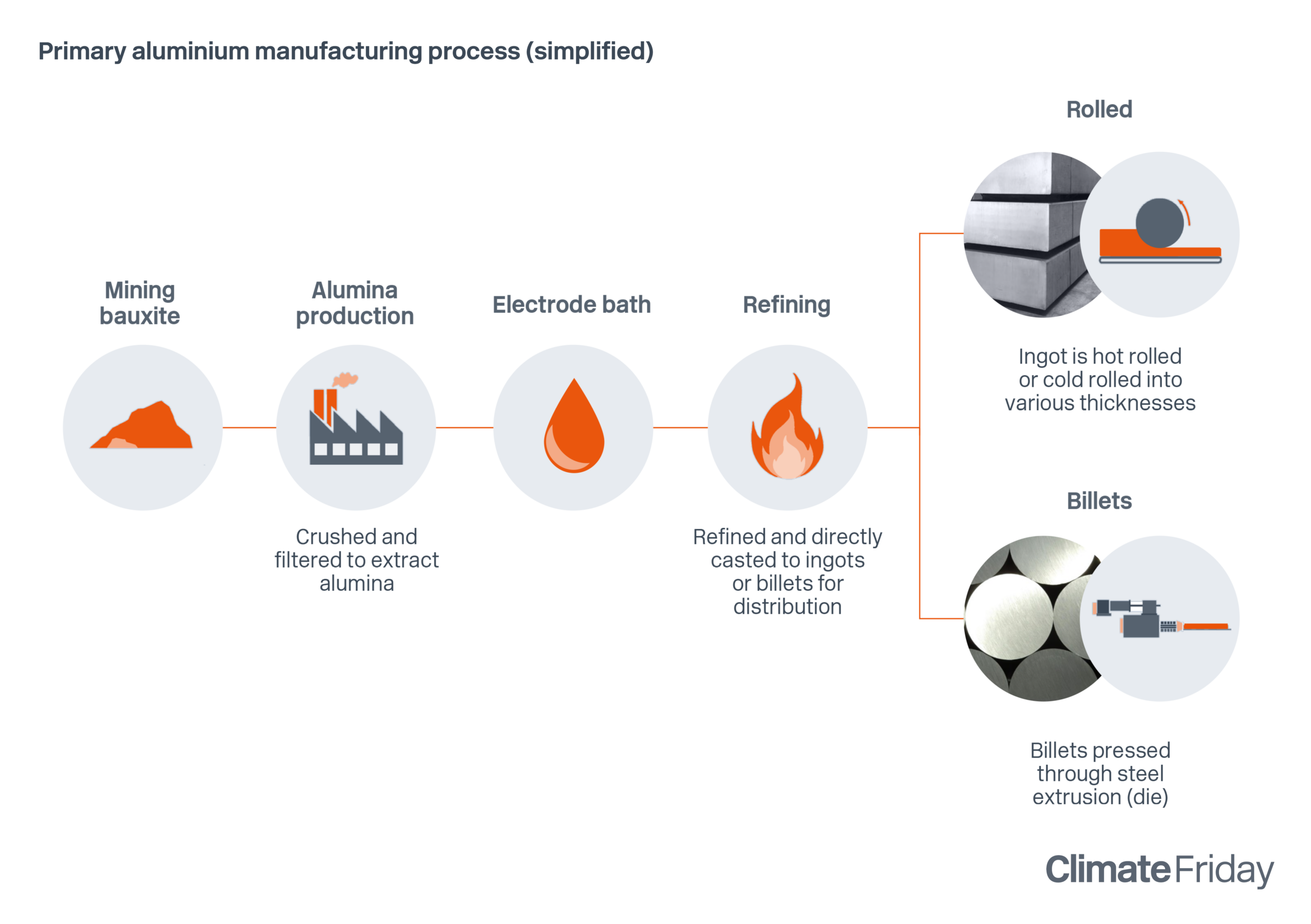
Once ready, the primary aluminium component is put into service, and once it reaches its service life, is deconstructed and dismantled. At this point, the material may either be sent to landfill or reintroduced into the supply chain, where it is cleaned, remelted and reprocessed into a new recycled aluminium product. This recycling loop can be repeated indefinitely with minimal material loss and no degradation in quality. Furthermore, since the majority of energy consumption occurs during the mining, refining and electrolysis stages, recycling aluminium delivers substantial energy and carbon savings. However, when specifying recycled aluminium, it is important for designers to understand the source of its recycled content. Recycled aluminium generally falls into two categories: pre-consumer waste and post-consumer waste, both of which are described below.
Pre-consumer waste | Aluminium scrap generated during the production of billets into finished or semi-finished products (e.g., profiles, sheets) before reaching the end user.
Post-consumer waste | Aluminium products that have reached the end of their service life and are removed through demolition and dismantling.
Embodied Carbon Accounting Methods: Cut-Off and Avoided Burden
Having developed an understanding of what goes into a recycled aluminium product, we can now examine the main carbon accounting methods. Two principal methodologies exist: the cut-off approach and the avoided burden approach. The primary distinction between the two lies in the treatment of the embodied carbon associated with pre-consumer waste. The two concepts are described below.
Cut-off approach | In the cut-off approach the concept is that the carbon footprint follows the production of the product itself. As such, the embodied carbon of the pre-consumer waste within your recycled aluminum product is considered from the point at which it is reintroduced into the manufacturing line. Pre-consumer waste is accounted like post-consumer waste: only the energy required to remelt and process it into a new product is added.
Avoided burden approach | In this approach, instead of the carbon footprint following the product itself, the carbon follows the material. That is to say that the embodied carbon of pre-consumer waste includes all energy from the extraction of the bauxite ore through to the production of the original aluminium and into the final recycled product.
The worked example below demonstrates how the cut-off and avoided burden approaches are applied and how each account for the embodied carbon of pre-consumer scrap. It outlines the calculation process for both the primary aluminum production that generates the scrap and the recycled aluminum product that subsequently makes use of it.
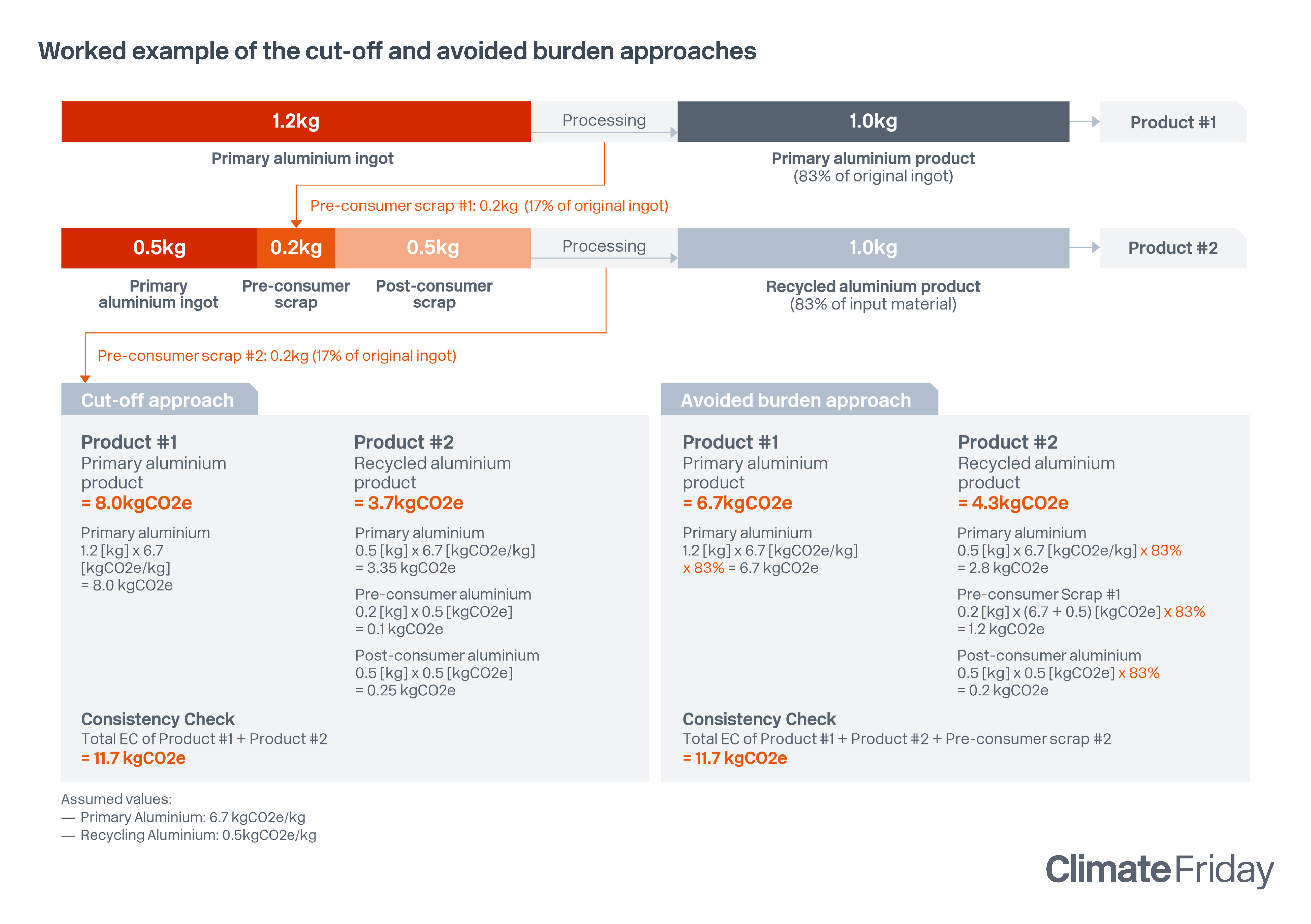
The worked example above, may take some time to fully understand, so to provide some clarity, lets highlight the key takeaways. As the final results show, the cut-off and avoided burden approaches lead to varying final embodied carbon values for both the primary and recycled aluminium products. This happens because under the cut-off approach, the embodied carbon associated with pre-consumer scrap is attributed to the primary aluminium product that generates it (product #1). Consequently, when this scrap is used in a recycled aluminium product (product #2), it carries no associated carbon. In contrast, the avoided burden approach assigns the embodied carbon of pre-consumer scrap to the recycled aluminium product that uses it (product #2), rather than to the original primary product (product #1). The final embodied carbon of the recycled aluminium product therefore ends up higher than if the cut-off approach had been considered. A consistency check between the two methods shows that no carbon leakage occurs between them. However, this remains true only if the carbon accounting method is applied consistently from product #1 to product #2, as switching between methods can result in either unaccounted-for emissions or double counting.
So, what do we follow?
As demonstrated in the worked example above, the cut-off and avoided burden approaches can produce varying embodied carbon values for the same recycled aluminium product. This raises an important question: which of the two methods provides the most accurate and which provides the most appropriate representation of embodied carbon?
An examination of EPDs published by aluminium suppliers worldwide suggests that the majority primarily adopt the cut-off approach when calculating embodied carbon. The implications of which can be illustrated through the EPDs published by the Italian based aluminium supplier Fonderie Pandolfo. In comparison to many other suppliers, Fonderie Pandolfo provides full transparency by reporting embodied carbon values for its low-carbon products using both the cut-off and avoided burden approaches. As shown in the graph below, for an identical recycled aluminium product composed of 19% post-consumer waste, 61% pre-consumer waste, and 20% primary aluminium (Fonderie Pandolfo, 2022) the embodied carbon calculated using the avoided burden approach is 3.7 times higher than that calculated using the cut-off approach. This discrepancy is highly significant and underscores the critical importance of understanding these methodologies.
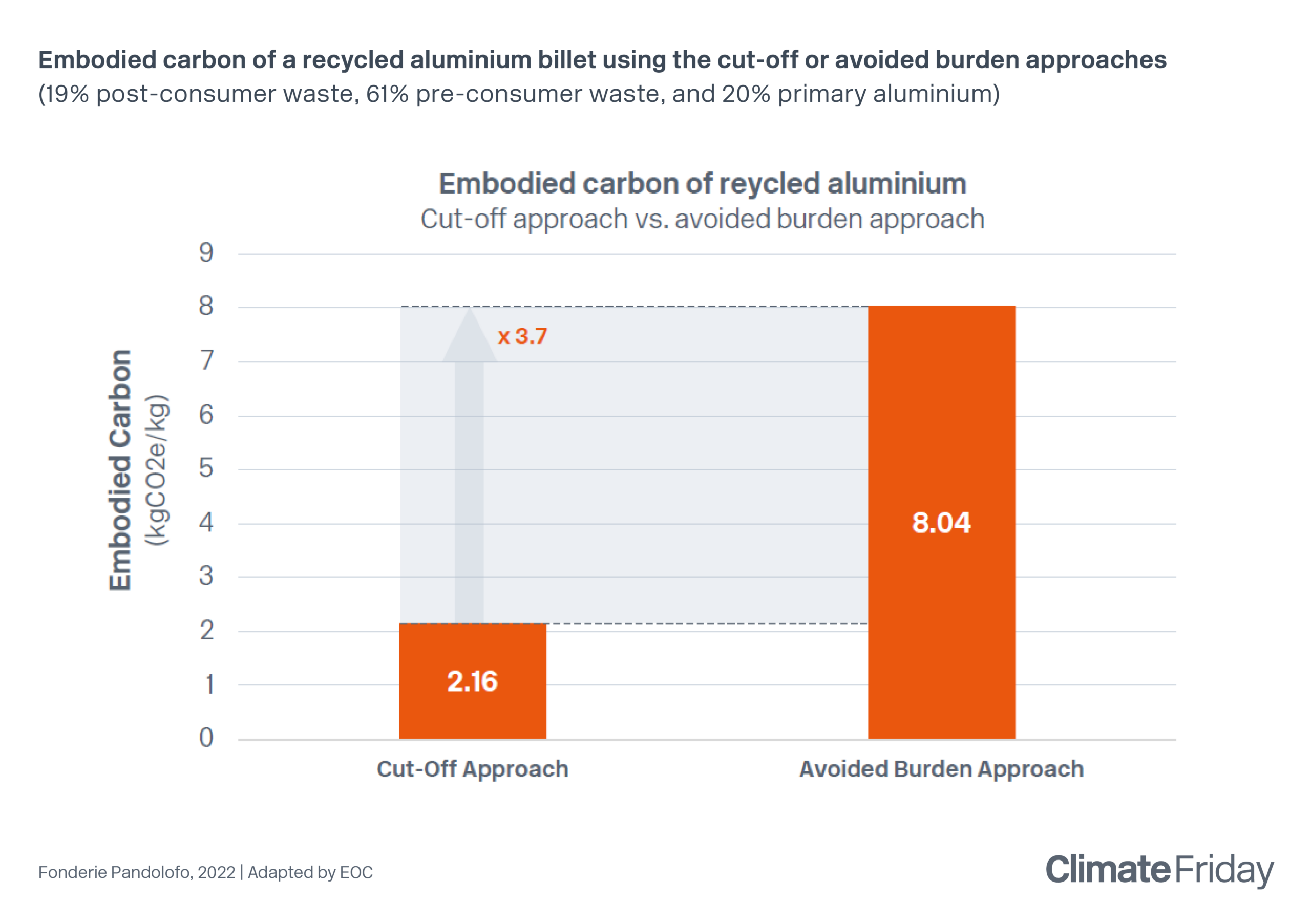
The challenge we face here is that neither method is inherently more accurate than the other. As shown in the worked example above, when assessed across the full system boundary, both methods ultimately account for the same total embodied carbon. However, this global equivalence does not imply that both approaches offer the same level of insight at a product level. The avoided burden approach provides greater granularity and transparency by explicitly attributing embodied carbon to the materials that make up the aluminium product. Importantly, it distinguishes between pre-consumer and post-consumer scrap, which should not be treated as equivalent, given they represent fundamentally different degrees of circularity. By more accurately reflecting what is physically present within the aluminium product, the avoided burden approach offers a clearer and more representative assessment of embodied carbon. On this basis, it could be concluded that the avoided burden approach provides a more transparent and therein more accurate carbon accounting method for low carbon aluminum. However, whilst this may indeed be the case, the question of which method is most appropriate remains open.
The avoided burden approach may offer greater granularity and transparency, however, it also introduces increased complexity. Many suppliers report that they lack the detailed data required to apply the method accurately, as it demands full visibility and control across both upstream and downstream activities. For suppliers where such control exists, the avoided burden approach can be applied effectively. However, for most suppliers, their supply of pre-consumer scrap is not entirely internal, some may come from other plants, whilst some may be off cuts from external fabricators or contractors. It therefore becomes very complicated for them to understand and assign the correct embodied carbon to each piece of pre-consumer waste. While a generic value could be assumed in theory, this may be overly conservative, potentially resulting in higher reported embodied carbon values compared to competitors and placing such suppliers at a disadvantage in tenders where embodied carbon is a key selection criterion. In these cases, the cut-off approach offers a more practical and possibly appropriate method of carbon accounting, without leading to mis-accounting of embodied carbon at a global level.
Conclusion
Throughout this article, we have shown that the choice between the cut-off and avoided burden approaches can result in substantial variation in reported embodied carbon values for the same recycled aluminium product. This places a responsibility on designers to understand how EPD carbon values are calculated and the implications of each accounting method. The avoided burden approach provides greater transparency by distinguishing between pre- and post-consumer scrap, but requires a level of data and supply-chain visibility that many suppliers cannot yet provide. In contrast, the cut-off approach provides a more pragmatic and simple method that avoids mis-accounting at a global level. Ultimately, no single method can be considered universally more “correct” than the other. The appropriateness of each depends on the objectives of the assessment, the availability of data, and the desired level of transparency.
For designers, the key takeaway is not simply the embodied carbon value itself, but an informed understanding of how that value is derived and the assumptions that underpin it.
Written by Haakon Lim.
Bibliography
Hartman, H. and Williams, J.J. (2024). Materials. Routledge.
Wenjuan Liu, Sravan Chalasani, and Iris Wu, Aluminium GHG Emissions Reporting Guidance, RMI, 2023.
Fonderie Pandolfo (2022). Environmental Product Declaration for Aluminium Billets. Stockholm, Sweden: The International EPD System – c/o EPD international AB.